

Luis de Pablo
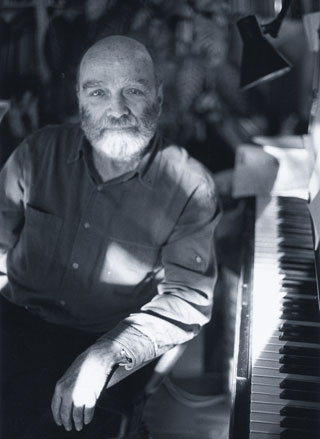
Luis de Pablo (Bilbao, 1930) is one of the most important Spanish composers of contemporary art music. He played a pioneering role in disseminating avant-garde music in Spain through organizations such as Time and Music (1959) o Alea (1965). He created the first electroacoustic music laboratory in Spain and has taught at numerous universities worldwide. He holds an honorary doctorate from the Complutense University of Madrid and is a member of the Royal Academy of Fine Arts of San Fernando. Among other awards, he has received the National Fine Arts Prize, the Spanish National Music Prize, and the Medalla de Oro del Círculo de Bellas Artes.
His work, characterized by creative freedom and formal rigor, has explored a wide range of musical discourses, including theatrical and cinematic experiences, forays into electronic music, and a respectful engagement with non-Western musical traditions. Some of his best-known works include: Inventions (1955-1960), Comments on two texts by Gerardo Diego (1956) Piano Sonata (1958) Radial (1960) Book for the pianist (1961) Polar (1962) Tomb (1962-1963), Caesuras (1963) Solutions (1964-65), initiatives (1966) Four inventions (1969) We (1970) Elephants ivres I-IV (1973) Le Prie-Dieu sur la terrasse (1973) I imagined portrait (1974-1975), Zurezko olerkia (1975) Darkness of the water (1978) Kiú (1982) Paths of the air (1987) The indiscreet traveler (1988) Figure in the sea (1989) Ancient faith (1990) The mother invites everyone to eat. (1992) Miss Cristina (2001) Fantasies (2001) Almost a mirror (2004) Second trio (2005) o A park (2006).
Updated March 15, 2016
Related content
There is no linked content at this time.