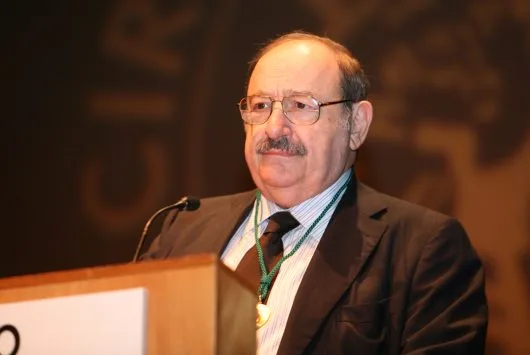
Umberto Eco
Umberto Eco (Alessandria, 1932), Italian novelist and semiotician, received his doctorate in Philosophy from the University of Turin in 1954 with a dissertation on Saint Thomas Aquinas, which he published two years later under the title The Aesthetic Problem in Saint Thomas Aquinas (1956). Thomistic philosophy and medieval culture are two of the themes that run through his work, emerging explicitly in the novel The Name of the Rose (1980).
A professor at the universities of Turin, Florence, and Milan, he published important semiotic studies in the 1960s, such as * Open Work* (1962) and *The Absent Structure * (1968), which exhibited an eclectic approach. Since 1971, he has held the Chair of Semiotics at the University of Bologna. There, in February 2000, he founded the Higher School of Humanistic Studies.
Eco has also cultivated the essay, a genre to which they belong Open work (1962) Daily minimum (1963) Apocalyptic and integrated in the face of mass culture (1965) The missing structure (1968) The house costume (1973) Form and content (1971) The sign (1973) Treatise on general semiotics (1975) The mass superman (1976) From the periphery to the empire (1977) Reader in fabula (1979) Semiotics and philosophy of language (1984) The limits of interpretation (1990) Six walks through narrative woods (1990) The search for the perfect language (1994) Kant and the platypus (1997) and Five moral writings (1998).
He holds honorary doctorates from more than thirty universities worldwide, is a Knight of the French Legion of Honor, and received the Prince of Asturias Award for Communication and Humanities in 2000. In 2009 he was awarded the Medalla de Oro from the CBA.
He died in Milan in February 2016
Updated April 22, 2025