

Religión y violencia
All evidence indicates that the religious factor not only persists in modern societies but is also capable of diversifying its forms or adopting new ones without losing the traditional ones; or of adapting to the changing needs of the citizen of the third millennium. The persistence of old cults and the invention of new ones, the importation of spiritualities, and syncretisms of all kinds are features that illustrate the positive side of this phenomenon: the persistence of the sacred, inexplicable to many. The sinister side of the same phenomenon is revealed in the rise of fundamentalisms, in deadly conflicts that use religion as a pretext, and in the attempts of religious denominations to determine, or merely condition, public life—an attempt that sometimes succeeds.
The end of the second millennium and the end of the third (in our reckoning) reveal to us the complexity of intertwined histories, interrupted projects, and conflicting purposes within the space-time of globalization. Many of these projects, purposes, and histories bear the mark of transcendence, the sign of one religion or another. Today we know that understanding our world, if it is at all possible, cannot do without investigating and questioning the religious sphere.
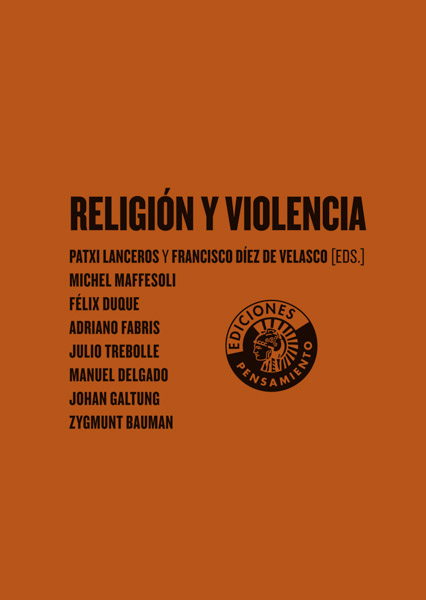
This volume brings together the lectures given at the congress Religion and violence, celebrated on el Círculo de Bellas Artes in May 2007. Includes texts from Michael Maffesoli, Felix Duke, Adriano Fabris, Julio Trebolle, Manuel Delgado, Johan Galtung, Patxi Lancers, Francisco Díez de Velasco y Zygmunt Bauman.
- Author
- PATXI LANCEROS AND FRANCISCO DÍEZ DE VELASCO (EDS.)
- Collection
- Exhibitions
- Price:
- 15
- ISBN:
- 978-84-87619-47-2
- pages:
- 304