

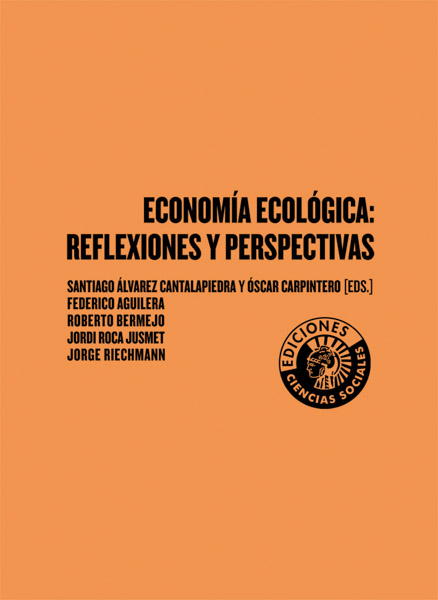
Economía Ecológica: reflexiones y perspectivas
Ecological economics provides a systemic view of the relationship between the economy and the biosphere and, in particular, highlights the tension between the excessive scale of economic activity and the conservation of nature. This clash between the expansive growth of the economy and the environment gives rise to countless distributive conflicts of an "eco-social" nature, the root "eco" being the prefix that characterizes the two terms that make up the expression "ecological economics."
Every economic decision is preceded by a distributive struggle and the subsequent development of any activity
This has implications for the distribution not only of economic value, but also of the social and environmental costs associated with this process. In this sense, environmental problems are largely the result of inequality in the appropriation of environmental space and in decision-making. There are those who, based on their social position and the tasks they perform (managing the cultural, financial, political, and military spheres), have the power to make decisions that affect everyone, and there is also a large majority deprived of the ability to immediately alter the decisions of the former. Therefore, responsibilities for environmental degradation are not equivalent, nor are the effects of this degradation on different population groups. Without critically examining the rules of the game and the power structures linked to economic activity, it is difficult to reverse the processes of ecological degradation—no matter how often sustainability is invoked like a mantra.
Santiago Álvarez Cantalapiedra He holds a PhD in International Economics and Development. He has been a professor at the
departments of Applied Economics and Sociology at the University of Valladolid and currently directs the CIP-Ecosocial and the magazine Papers on ecosocial relations and global change.
Oscar Carpintero He is a professor of Applied Economics at the University of Valladolid. His work combines the approach
and the investigation of ecological economics through the study of the history of economic thought. This resulted in his work popularizing the thought of Georgescu-Roegen, one of the greatest ecological economists of the 20th century. Among his publications, the following books stand out: The metabolism of the Spanish economy: Natural resources and ecological footprint (1955-2000) (César Manrique Foundation, 2005) and Georgescu-Roegen's bioeconomy (Montesinos, 2006).
[Co-published with CIP-Ecosocial ]
- Author
- Santiago Álvarez Cantalapiedra and Óscar Carpintero (eds.)
- Editorial:
- [Co-published with CIP-Ecosocial]
- Collection
- 4
- Price:
- 13
- ISBN:
- 978-84-87619-52-6
- pages:
- 216