
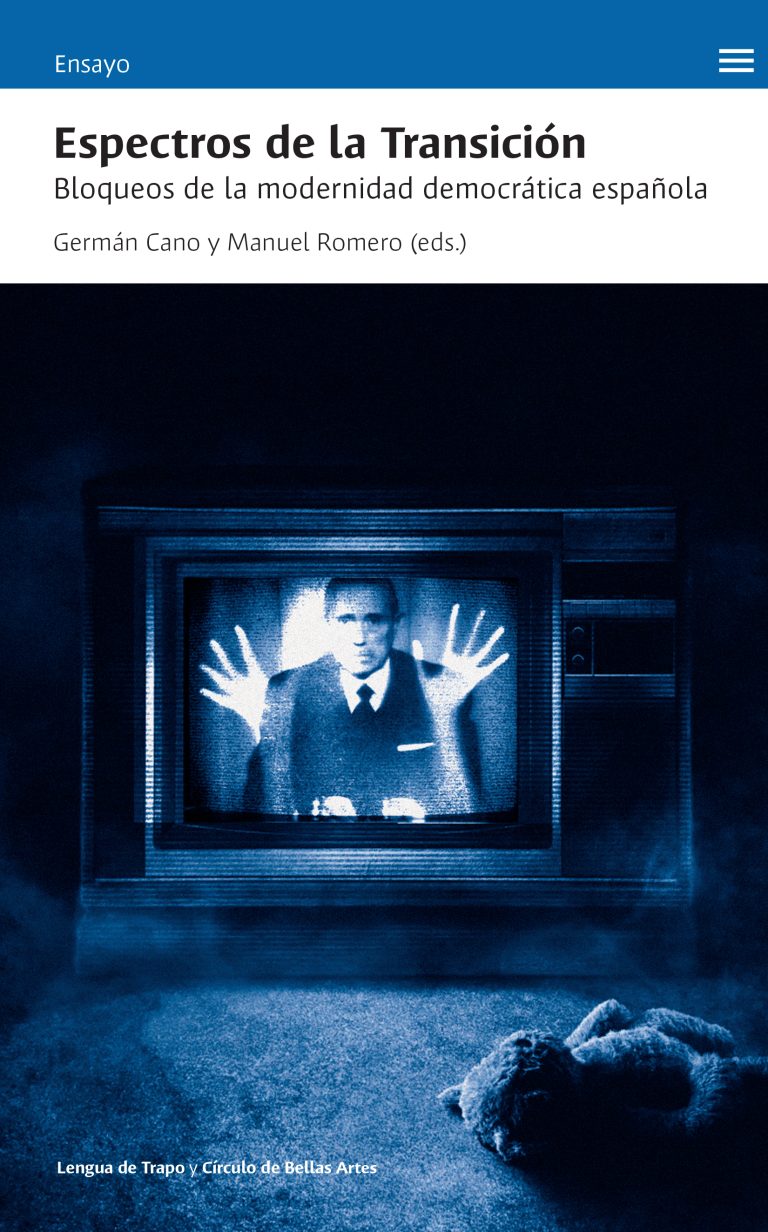
Espectros de la Transición
Available from May 7.
"After Franco's death in bed, the positive project of building Spain that existed from the most conservative and reactionary right wing was dismantled; but paradoxically, that death also dismantled the opposition discourse. We entered a new, almost melancholic scenario of fragmentation of any collective political horizon."
What if the true transformation that shaped Spanish society wasn't the transition triggered by Franco's death, but rather the one that began in the late 50s with the spread of television, tourism, and the American way of life ? "Contrary to the narratives that tend to hail the desire for freedom in Spain—first during the developmentalist period and then in post-Francoist Spain—as a modernized social body, a very different scenario is actually presented here," the editors of * Specters of the Transition * tell us . From this perspective, they analyze the shift from a culture of resistance under a climate of fear to a modern "showcase culture"—the Expo, the Olympics, the grand celebrations—that would pave the way for the subsequent conservative revolution.
Drawing on various works, this essay seeks to understand what has changed in the last fifty years: Why was the supposedly secular, rational, and technocratic "Spanish economic miracle" portrayed through providential and supernatural elements? Which female icons embodied the new spirit of modernity? What would our social memory be like if documentaries had been produced in the 1980s that reflected the reality—working-class, rural, neighborhood—that didn't change overnight? What political benefits can we derive from an emotional connection to our country? How has our capacity for storytelling transformed in recent decades? And, ultimately, what ideological and emotional transformation did the Transition bring about?
The following signatories reflect on all of this: Ana Fernández-Cebrián, Eduardo Maura, Luis López Carrasco, María Rosón, Ana Pol, Gloria Durán, Nuria Sánchez-Madrid, Antonio Rivera García and Steven Marsh.
Germán Cano is a tenured professor of Contemporary Thought in the Department of Philosophy and Society at the Complutense University of Madrid. Specializing in contemporary philosophy, the topics and authors he has studied particularly help him to focus his reflection on the critical connection between political philosophy and new subjectivities.
Manuel Romero is the director of the Institute of Cultural Studies and Social Change (IECCS) and a doctoral candidate at the Complutense University of Madrid with a thesis on the itineraries of Antonio Gramsci in contemporary thought.
- Author
- Germán Cano and Manuel Romero (eds.)
- Editorial:
- Rag language and Círculo de Bellas Artes
- Collection
- Rag tongue
- ISBN:
- 978-84-8381-291-4
- pages:
- 256
- Dimensions
- 22’4x14x1’5 cm